
- Katılım
- 17 Eki 2024
- Mesajlar
- 5
- Tepkime puanı
- 15
- Puanları
- 1
At the inland terminal of Alblasserdam, near Rotterdam, the crew of H2 Barge 2 is engaged in an unconventional refuelling operation: loading containers filled with green hydrogen, produced using renewable energy. Unlike traditional diesel-powered ships, this vessel emits no CO2.
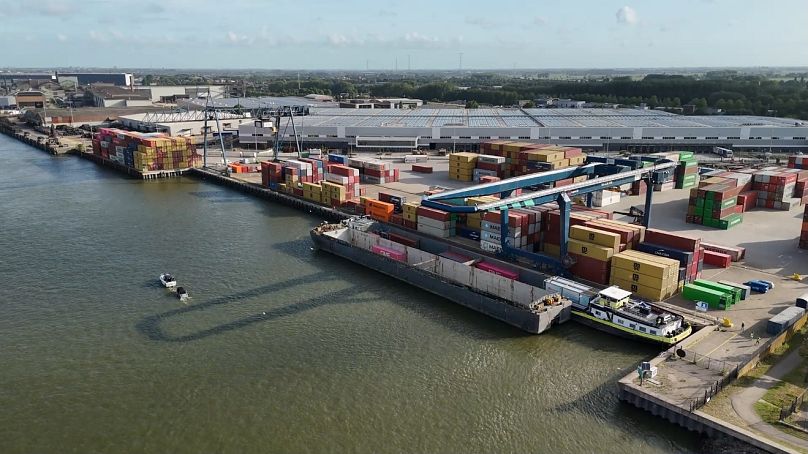 H2 Barge 2 at the inland terminal of Alblaserdam, ready for bunkering “Our barges can sail approximately 100 trips per year for a round trip of 500 kilometres. This ensures a saving of 2,000 metric tonnes of CO₂ per year”, explains Sara Ravazza, managing director of Future Proof Shipping.
The company began in 2017 as a consultancy helping clients decarbonise their shipping operations. Determined to demonstrate that absolute zero emissions were possible, they eventually acquired and retrofitted an old diesel-powered vessel with a hydrogen-electric propulsion system. H2 Barge 1 was launched in 2023, followed by H2 Barge 2 a year later.
“Our vessels have been fitted with an electric motor and fuel cells”, explains Tony Virvilis, a naval architect at Future Proof Shipping, “fuel cells are devices that convert hydrogen to electricity and water. This electricity is being used by the vessel for its propulsion.”
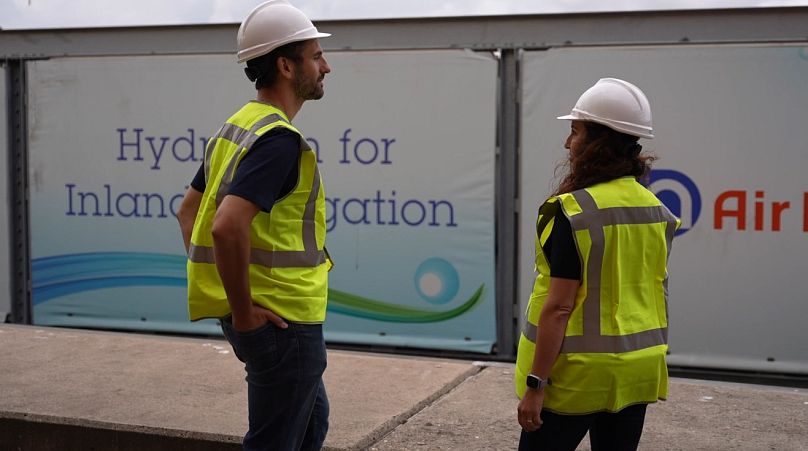 Sara Ravazza, managing director, and Tony Virivilis, naval architect, at Future Proof Shipping For Captain Dragoş Lupu, who has spent 18 years at sea, the transition to hydrogen power has been transformative.
“Everything is silent and there are no vibrations, just silence. The vessel gives off only water vapour. This is important for our health and for the health of the next generations.” Dragoş Lupu Captain of H2 Barge 2 Captain Dragos Lupu working on board of H2 Barge 2 <b>The shipping sector needs more incentives to accelerate its decarbonisation</b>
Despite this success, scaling up remains a challenge. Hydrogen is still costly, and few incentives exist to make green shipping financially competitive.
“It is very important that customers understand that an absolute green solution exists and is reliable but they must also be prepared to pay for it.” Sara Ravazza Managing director of Future Proof Shipping She also stresses the need for stronger policy support to encourage a shift away from fossil-fuelled vessels.
H2 barge 2, crossing the Erasmus bridge in Rotterdam The retrofit of the two ships was made possible in part through the European Union’s Zero Emission Ports North Sea (ZEM Ports) initiative, which aims to accelerate the decarbonisation of the shipping sector. Future Proof Shipping is a partner in the €3.6 million transnational project, co-funded by the EU’s Cohesion Policy through the Interreg North Sea programme and four additional partners.
Future Proof Shipping received about 10% of its retrofitting costs through ZEM Ports. According to Ravazza, the initiative’s support sent a clear message to the industry that the European Union believes in hydrogen.
The company began in 2017 as a consultancy helping clients decarbonise their shipping operations. Determined to demonstrate that absolute zero emissions were possible, they eventually acquired and retrofitted an old diesel-powered vessel with a hydrogen-electric propulsion system. H2 Barge 1 was launched in 2023, followed by H2 Barge 2 a year later.
“Our vessels have been fitted with an electric motor and fuel cells”, explains Tony Virvilis, a naval architect at Future Proof Shipping, “fuel cells are devices that convert hydrogen to electricity and water. This electricity is being used by the vessel for its propulsion.”
“Everything is silent and there are no vibrations, just silence. The vessel gives off only water vapour. This is important for our health and for the health of the next generations.” Dragoş Lupu Captain of H2 Barge 2 Captain Dragos Lupu working on board of H2 Barge 2 <b>The shipping sector needs more incentives to accelerate its decarbonisation</b>
Despite this success, scaling up remains a challenge. Hydrogen is still costly, and few incentives exist to make green shipping financially competitive.
“It is very important that customers understand that an absolute green solution exists and is reliable but they must also be prepared to pay for it.” Sara Ravazza Managing director of Future Proof Shipping She also stresses the need for stronger policy support to encourage a shift away from fossil-fuelled vessels.
H2 barge 2, crossing the Erasmus bridge in Rotterdam The retrofit of the two ships was made possible in part through the European Union’s Zero Emission Ports North Sea (ZEM Ports) initiative, which aims to accelerate the decarbonisation of the shipping sector. Future Proof Shipping is a partner in the €3.6 million transnational project, co-funded by the EU’s Cohesion Policy through the Interreg North Sea programme and four additional partners.
Future Proof Shipping received about 10% of its retrofitting costs through ZEM Ports. According to Ravazza, the initiative’s support sent a clear message to the industry that the European Union believes in hydrogen.